1993/07 Rockies trip - Craters of the Moon |
|||||
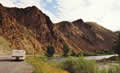 We left Canada to its rain and headed south on 93 to Montana, where it still seemed to be raining. At the first town, they told us that the good weather was still 200 miles away. As we had nearly 2000 to do to get to Arizona, this wasn't too daunting.
This was a traveling day, as there was nowhere special we could get to in one day. We drove
through Montana's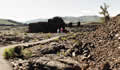
 cowboy country around Flathead lake, and then south across the Flathead
reservation to Missoula, which is big enough to have a K-Mart and relatively cheap groceries. We carried on to Hamilton, which is close to the Idaho border, and camped at a "sportsman's
paradise", all rods and bait and guns and ammo. Still, OK for one night, and we knew we had to
get an early start for the next day.
cowboy country around Flathead lake, and then south across the Flathead
reservation to Missoula, which is big enough to have a K-Mart and relatively cheap groceries. We carried on to Hamilton, which is close to the Idaho border, and camped at a "sportsman's
paradise", all rods and bait and guns and ammo. Still, OK for one night, and we knew we had to
get an early start for the next day.
 Thursday July 8th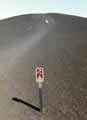
The Bitterroot pass into Idaho was being reconstructed, so we had to be there before
they closed the road at 8 am. We were about the last vehicle through, so after a very bumpy few
miles, we just about had the road to ourselves. The road follows the Salmon River and is very scenic, but the whole area is very empty except during hunting season. The Salmon is also known as the River of No 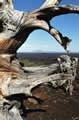 Return and is becoming popular for raft trips, so maybe we'll stop off there on a future trip.
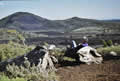
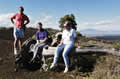 The scenery soon turns to desert as you leave the mountains, and climb to the plateau known as "Craters of the Moon".
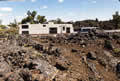
  This whole plateau is the result of a million years or so of volcanic
seepage, but the park covers a smaller area that was active only a thousand years ago, so it is
mainly black, a landscape of lava flows, cinder cones, and pieces of crater wall. It's a bit like camping in a steam railway depot in the days of coal. Everything and everyone soon builds up a
layer of black clinker.
This whole plateau is the result of a million years or so of volcanic
seepage, but the park covers a smaller area that was active only a thousand years ago, so it is
mainly black, a landscape of lava flows, cinder cones, and pieces of crater wall. It's a bit like camping in a steam railway depot in the days of coal. Everything and everyone soon builds up a
layer of black clinker.
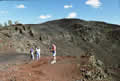
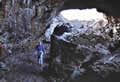
For once, the weather was beautiful, so we spent a few hours climbing around cones and flows, and looking at the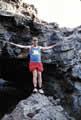 surrounding scenery. The air here is about the clearest in the USA, so you can see 50-80 miles from the top of the cones. We also went to look at the caves. These are lava tubes, left empty when the lava flowed out a thousand years ago. The lava is such a good insulator that there is still ice in the tubes from last winter.
The tubes are several hundred feet long and littered with boulders and ice, and there's no light once you take the first bend, so we were thankful for the flashlight. This didn't show up the stalactites very well, so John is now a couple of inches shorter.