2005/09 Labrador trip - Goose Bay |
|||
The day was still sunny but getting increasingly windy. When we came to the end of the road there were turnings to Goose Bay and Happy Valley. We stopped at the Goose Bay visitor centre and got directions for Sandie to buy buttons, and also found out that the local campground was still open. We were approaching Goose Bay's one traffic light when I spotted a large flapping thing floating over the road. It wasn't a giant eagle, but it was a roof! It had been peeled off a nearby store and been blown across their parking lot. It came down in the middle of the intersection, missing all the cars. It was still moving around on the ground so we all drove around it, giving it a wide berth.
We were the only campers at the Goose River Lodge campground and they had to open up the bathroom and showers for us. This confirmed what we'd thought, that we were the only campers on the road. There were a couple of tourist groups traveling the road in cars and staying at hotels. We heard a horror story about one of these. He had come to a section of road that was being graded. The grader works on about five miles at a time and makes two or three passes with the blade. In between these passes the road has a long windrow of gravel in the middle. When you meet the grader you may have to drive up and over one of these. This driver had been unlucky enough to pick a spot where the windrow was hiding a large rock and it ripped out the engine's oil pan. Apparently, a week later, he was still in a hotel waiting for parts to arrive.
Friday September 30th
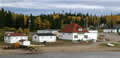 Friday was still very windy but
we had blue skies when we set out to explore the area. There are
three more communities at this end of the road, Northwest River
(where the Hudson Bay company built its first trading post),
Sheshatsiu, an Innu Indian town, and Mud Lake, an Inuit community,
only accessible by boat or snowmobile. We drove to Northwest River, a
neat and tiny place almost surrounded by the waters of Melville and
Grand Lakes. These are both connected to the Labrador Sea and are
tidal, though not very salty.
Friday was still very windy but
we had blue skies when we set out to explore the area. There are
three more communities at this end of the road, Northwest River
(where the Hudson Bay company built its first trading post),
Sheshatsiu, an Innu Indian town, and Mud Lake, an Inuit community,
only accessible by boat or snowmobile. We drove to Northwest River, a
neat and tiny place almost surrounded by the waters of Melville and
Grand Lakes. These are both connected to the Labrador Sea and are
tidal, though not very salty.
The Hudson Bay post has been
restored and is now a museum but was closed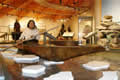 until Sunday, so we went
looking for the town's Interpretive Centre, where we met the curator
Amos. He showed us around for nearly three hours, with only a small
amount of time looking at exhibits (which were very good, even though
they weren't complete yet). I think he was delighted to have some
visitors who knew a little bit about his favourite subjects. We heard
all about the drive for Labrador's independence from Newfoundland,
and the conflicts between the four cultural groups: settlers, Innu
(Indian), Inuit (Eskimo),
until Sunday, so we went
looking for the town's Interpretive Centre, where we met the curator
Amos. He showed us around for nearly three hours, with only a small
amount of time looking at exhibits (which were very good, even though
they weren't complete yet). I think he was delighted to have some
visitors who knew a little bit about his favourite subjects. We heard
all about the drive for Labrador's independence from Newfoundland,
and the conflicts between the four cultural groups: settlers, Innu
(Indian), Inuit (Eskimo), 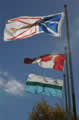 and Metis (English and Inuit mixture). We'd
already noticed that Labrador had its own flag, and we'd seen a lot
more of those than the somewhat cryptic red, white, and blue flag of
the combined province of Newfoundland and Labrador. He said there was
a lot of controversy about the building of a causeway across the
Churchill River to carry the road on to Cartwright. It sounded like a
good idea to us as people would then be able to drive to the coastal
communities instead of having to take the ferry, but he said most
people liked their isolation and didn't want any change.
and Metis (English and Inuit mixture). We'd
already noticed that Labrador had its own flag, and we'd seen a lot
more of those than the somewhat cryptic red, white, and blue flag of
the combined province of Newfoundland and Labrador. He said there was
a lot of controversy about the building of a causeway across the
Churchill River to carry the road on to Cartwright. It sounded like a
good idea to us as people would then be able to drive to the coastal
communities instead of having to take the ferry, but he said most
people liked their isolation and didn't want any change.
We were probably his only visitors for the day, and he made sure we were informed! Amos is a native of North West River and a mixture of English, Scots, and Inuit, but his accent sounded more Irish to me.
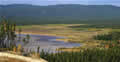 We went up Sunday Hill to look at
the view. Sunday Hill seems to be the town's picnic place as it has
wooden decks overlooking the lakes on either side. The wind was very
strong up there, but we were treated to a complete rainbow from a
storm rolling in from the Mealy Mountains.
We went up Sunday Hill to look at
the view. Sunday Hill seems to be the town's picnic place as it has
wooden decks overlooking the lakes on either side. The wind was very
strong up there, but we were treated to a complete rainbow from a
storm rolling in from the Mealy Mountains.
We made one last stop in the town at the crafts store. The lady running the store used to be a nurse. She said that the bridge we'd just driven over was new, and they used to have to go across in a hand-operated cable car. She complained that the bridge was killing the community, as people would now go shopping in Happy Valley and the local stores couldn't compete and were closing. Her accent was really weird, sometimes sounding Dorset and sometimes Scottish. Like Amos, she'd lived all her life in North West River. She and her daughter had recently gone on a great adventure: taking the ferry to Cartwright, driving the coast road, taking another ferry to Newfoundland, and then another to Nova Scotia, and touring New Brunswick and Maine. She'd found the USA very expensive. As we were leaving she told us to be careful of wolves as a wolf pack had been hanging around the road.
We crossed the bridge and drove into Sheshatsiu past the Mounties Post and the Troubled Youth Centre. Sheshatsiu was a complete contrast to Northwest River, a dump without any bright spots. The Innu Indians are not doing very well.
Back in Goose Bay, we saw a crane putting the store's roof back on, a difficult job in the wind. We had a late lunch at the Mariner's Gallery where we were the only customers. Sandie wanted to have cod to celebrate being at the seaside, and I had a beef poutine just to find out what it was. It's fries and gravy and cheese with ground beef, quite tasty and very unhealthy. We took a quick tour of the remaining community, Happy Valley, but saw no reason to stay there.