2006/02 Southwest USA trip (NM-AZ) - Kilbourne Hole |
|||
 February 2006
Dear All,
By this time we had been on the road for three weeks and had just moved from Texas into New Mexico, so that seemed a good point to end Part 1 of our South West story and begin Part 2.
Tuesday January 24th
At the end of Part 1 we had just crossed into New Mexico and were on the rim of the ancient volcano known as 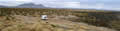 “Kilbourne Hole”, famous to gemologists as a source of peridot (green gems). We had little daylight left to find a way down to the crater floor, so we went back to the camper and drove around to where we could park on the rim and look out across the crater. Talk about a spectacular campsite! This is not a national park or monument, just a wonderful piece of scenery out in the desert.
As we were still close to El Paso we had lots of TV stations, some English and some in Mexican Spanish. The weather forecast was for rain the next day, the first in months so there was lots of excitement. We were going to be there for a couple of nights so hopefully the sand road would dry out a little before we left.
 Wednesday January 25th
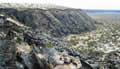
We had some light rain overnight but not enough to make much impact on the desert. The morning was dull and cloudy as we set off to climb 200 feet down the crater wall. This is government land administered by the Bureau of Land Management, but isn’t a national park, so there are no nice trails to get you to the attractions, or nice rangers to come and rescue you if you have a disaster. But there’s no one coming around to collect 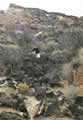 any fees, either!
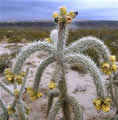
We were climbing down a pile of volcanic boulders, so it was heavy going, but luckily we had plenty of thorny bushes and the occasional cactus to hold on to. The floor of the crater has filled up with thousands of years of blown sand, and is now mainly flat desert with the usual mix of creosote bush, yucca, cactus, and various thorny shrubs. Wildlife seemed to be limited to jackrabbits, lizards, and a bunch of big, slow beetles, though we did see tracks from coyotes, mountain lion, and even cows. There must be an easier route into the crater somewhere.
We were looking for peridot, a gem-quality green crystal of olivine. Supposedly, the peridot is contained in “bombs” of volcanic rock. So you split the rock to look inside to see what you have. We did that for a while, and found a few crystals. There were also a few crystals scattered around on the sand. I got a bit fed up with pounding rocks, as I’d found that I’d injured by right elbow somewhere along the way, probably all that climbing in the canyons. So I took the brace off my left elbow, which was almost healed from last July’s kayaking, and put it on my right elbow. Welcome to old age!
I set off to walk a few miles across the crater to investigate what looked like a flying saucer landing pad in the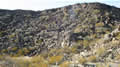 centre of the crater. It turned out to be a dried-up lake bed. On the other side of the lake bed were a number of run-off channels full of rock, and I started seeing small rocks faced with crystals. I followed the channels back to a great gash in the crater wall and then I was picking up big rocks full of crystals, so I loaded up my pockets and went back across the crater to Sandie. We stashed our tools and rocks away and both went across the crater.
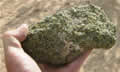 Then it was a struggle to decide what to keep: big rocks faced with crystals or little rocks with big crystals that Sandie can facet. We were running out of daylight, so we filled the backpack with rocks and we set off, yet again, back across the crater. Earlier that morning I’d had this vision of ending the day with just a handful of crystals but instead we had the usual ton of rocks. As I was trudging back across the salt flats and up the slope to the crater wall, the theme from Wagon Train kept going through my head. I think I was the guy that had lost his wagon and was having to walk to Oregon.
I hauled the rocks up the crater wall on wobbly legs and then went back down for Sandie, but she had not been able to find the stuff we’d stashed. I went to look for it but it was too late in the day and finding things in the dark against a black cliff was hopeless. I’d have to retrieve our gear the next morning.
As I was making the last climb up the wall with Sandie at the top lighting my way by flashlight, I heard an owl hooting. I looked up to see this figure perched on the rim of the wall. I wasn’t sure if this was the owl so I hooted back. No reaction, so I flapped my arms and the owl flapped his and took off, swooping down over me into the darkness. The Navajo believe an encounter with an owl is a warning of death. Luckily, I don’t.
Thursday January 26th
I had an early morning trip down the crater wall and easily found our tracks and then our cache of gear and rocks. There was little chance of their being stolen as we hadn’t seen anyone since we arrived on Tuesday.