2006/02 Southwest USA trip (NM-AZ) - Chiricahuan Mountains |
|||
We backtracked into New Mexico and Lordsburg, as there’s no road directly over the mountains to the south of us. We found a New Mexico Visitor Centre just outside Lordsburg with free Internet access, so we stopped there long enough to spray off a few e-mails and to resuscitate our bank account from our retirement savings. Just about all our bills are paid automagically but we do have to fill up the money hopper occasionally.
Then we were off along the freeway into Arizona, and this time we passed a sign welcoming us. Arizona’s “Welcome and Information Centre” rest area turned out to be unmanned though, with just a few displays and little useful information.
Our map showed there to be an interesting road taking off south from the freeway to Paradise, Arizona and crossing the Chiricahua Mountains into the national monument. It began with a notice that this was a “primitive road” and unmaintained, but in reality this road was quite good. When we got to Paradise the warning was of a single track mountain road, impassable to large vehicles. Paradise has a side street named “George Walker Avenue” (Maureen’s Dad, and my Uncle). I was surprised that a tiny place like Paradise even has street signs, but I would have been more impressed if we hadn’t needed four wheel drive to make it through the trenches of Main Street!
From Paradise, the route became an unmaintained forest road, with warnings that the route was used for smuggling drugs and immigrants in from Mexico. I think we’d have been tempted to camp in the forest but the warnings put us off. We later found that almost all remote roads in Arizona carry this warning. This one changed to a single lane track, switchbacking steeply up the east side of the mountains and more gently down the west side. Eventually, we came to the Chiricahua National Monument, where we flashed our new Golden Age passport and got in for nothing, and paid only $6 to camp. We were already making a profit on the card.
It was too late for any serious hiking but I went out to take a few pictures as the light faded. The sun was lighting up the top of the mountains. This is a very rugged area, and once was home to the Chiricahuan Apaches, including Cochise and Geronimo. They held out for about eighty years against the Europeans, but eventually the Apaches were sent to reservations in Florida. Today the survivors are in Oklahoma and New Mexico.
 Saturday February 4th
We decided to stay for another night as this looked to be a very interesting area. The Chiricahuan Mountains are an amazing collection of colourful cliffs topped by balanced rocks. The mountains are at the junction of the Chihuahua Desert that we’ve been traveling through since Big Bend and the Sonoran Desert that covers much of Arizona. They are also at the tail end of the Rockies and the beginning of the Mexican Sierra Madre. The result of these junctions is a great diversity of plants and animals. As well as the desert animals we’d already seen, this area has coati mundi, similar to raccoons, and even jaguars from Mexico have been seen there. The canyons are full of great convoluted white trees, similar to Australia’s ghost gums, but judging by the leaves on the ground underneath them they are sycamores.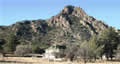
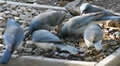 The park has a number of relics from the early settlers. I took an early walk past an old cabin and ranch house. Apparently the cabin was badly damaged by an earthquake back in 1885. That must have been an exciting day with all those balanced rocks becoming unbalanced! Back at the campground, I spilt some water and the spill was instantly a mass of Mexican jays. The creek that flows through the campground was dry, so those water spills were
 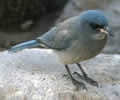 important to the birds.
While we were in the visitor’s centre Sandie spotted a book entitled “Growing up on the Lazy B” written by  Sandra Day O’Connor who recently retired from the US Supreme Court. Sure enough, it was the place where we’d just been prospecting for chalcedony and fire agate. Her family had the Lazy B for a hundred years, but her brother sold it about twenty years ago as none of the children wanted to continue – too much work, isolation, and risk, I guess. She makes a good point in her book that, although ranchers are often accused of overgrazing the land, they have the most to gain by using the land carefully. If they aren’t there to keep an eye on things the land is open to all kinds of misuse. Talking about misuse, in her book, she mentions that they saw a great explosion on the horizon back in 1945. It wasn’t until much later that they found out that it was the first atomic bomb going off at Alamagordo, nearly 200 miles to the northeast.
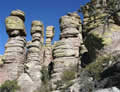 Geologically, the mountains are similar to the City of Rocks, volcanic tuff compressed and then eroded into
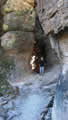
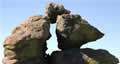
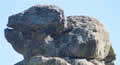 fantastic shapes and columns. The main difference is that these shapes are on tops of the mountains. The park road took us up to the mountain tops and we could see out across the rocks to the Sonoran Desert and the distant Dragoon Mountains. We walked the Echo Canyon trail, which led us through the shapes, down to the canyon floor, and then back up to more weird rocks. Some of the more obvious have been named, but everyone sees their own animals and relatives in the shapes. As well as visiting the rocks we were hiking amongst a maze of
  desert plants: yucca, sotol, agave, and prickly pear below the trees, a real desert diversity. The trees and shrubs
  included alligator juniper, Arizona cypress, apache pines, and manzanita, a beautiful shrub with tough redbranches and bark, a species I’d only seen before in California.
We made it back to the campground at sunset and I dragged Sandie along to see the Silver Spurs trail I’d hiked in the morning. We were rewarded with a nice sunset and a few deer snacking on the trees and pretending that we weren’t there. Luckily we had a bright half moon for our moonlight hike back to the campground. 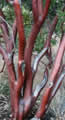
Sunday February 5th
Our intention on Sunday was to get to Saguaro park, but first we spent a while filling 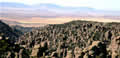 our water tanks by hand, time-consuming, but the water was good. The birds enjoyed the spills again. Then I noticed that we had a soft rear tyre, so I pumped that up and hoped that the tyre was still good. We took a short drive into Coronado National Forest to get a nice piece of manzanita for Sandie’s crafts. There was plenty within the park, but cutting shrubs inside a national monument is a good way to end up in jail.