2006/03 Southwest USA trip (AZ-MN) - Guadalupe Mountains |
|||
We spent most of the day down in the caverns, and left via the elevator as you’re not allowed to walk back out through the natural entrance. The caverns park has no campground, so we were going to camp in Guadalupe Mountains national park, about forty 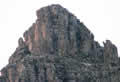 miles south, across the border into Texas. It was still warm and sunny for the drive south. The campground at Guadalupe wasn’t that great, really just a parking lot, divided up for camping, but the mountain scenery was impressive.
 There was a warning sign for tenters, pointing out that the local skunks had learned to open tent zips in search for food. That could really spoil your night’s sleep! I took a short walk along the Tejas Trail, but I didn’t see any skunks, just a few mule deer.
Thursday February 23rd
I took an early morning walk up to the ridge overlooking the campground, and it was very apparent that the weather was 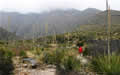 changing. Clouds moved in and hid the mountain tops around me, and a fine drizzle started as I walked back down. We’d planned to hike up McKittrick Canyon, and decided to go anyway and hope that the rain would pass us by. It didn’t!
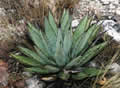
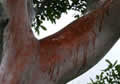 The canyon has the reputation of being the most beautiful place in Texas. I don’t know about that but I can certainly see that anyone who lived in the brown flatlands of west Texas could fall in love with this place. As we walked up the canyon and were enclosed by the limestone cliffs of the Guadalupe Mountains, we were moving from a desert environment dominated by sotols and yucca and agave to a forest of oaks and maples and juniper. Apparently in the fall the canyon is a blaze of orange and red leaves, rare in these southern parts. For variety, there were the madrone trees some with blazing red trunks, similar to some Australian gums. The rain streaks made the larger branches look like blood-stained limbs.
We ended our hike at the Pratt Cabin, a house built by the original owner of the canyon. He built his house from the natural limestone, which has natural right angles. There are a couple of tables there made from single sheets of limestone. He even used sheets of limestone to cover the roof. Luckily, he didn’t put any doors on his garage so we were able to eat our lunch in there out of the rain which had become much heavier as we walked. Pratt subsequently gave the canyon to the nation and it eventually became part of the park.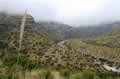
Sandie was cold and hurried back to the camper while I strolled back and took pictures. On the way, I heard the grunts of javelina (the pigs) but never saw them. I met up with a couple from Utah who worked for the park service. They were enthralled to be walking the canyon in this unusual weather. After seven weeks of sunshine and dry weather I had to agree that there was some novelty in viewing the mountains through fog and rain, but an hour’s worth would have been sufficient!.
When we returned to the campground, the rain had eased off but the fog had settled in. I took a walk along one of the nearby trails. I could see about ten feet, so the world was limited to a view of the nearest cactus or sotol or juniper. It’s not often you get to see the desert under such strange conditions.
Friday February 24th
It rained most of the night but the morning was glorious sunshine with the kind of crystal-clear air that comes after a rain. I hiked 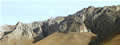 up the ridge again, enjoying the sun and contemplating perhaps staying another day to hike the McKittrick Canyon in sunshine. However, by the time I came down, the clouds were already moving in. Later, as we drove south towards Van Horne, the major mountains of El Capitan and Guadalupe Peak had disappeared into the clouds and we had a fine drizzle.
Next.