2019/11 Australia trip - Mungo |
|||||
 Sunday November 17th
It was a sunny morning with a cold wind as we set off from the deserted motel and bar. We were going to spend our day at Mungo national park, off to our east.. We were taking the more remote northern route as it looked more interesting, and so it proved.
 |
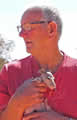
Stumpy Tail (0.58) |
 |
|---|
|
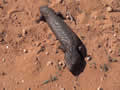
Mungo Joey Dashcam (3.00) |
 |
|---|
|
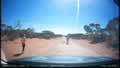
Mungo Joey rescue (3.47) |
 |
|---|
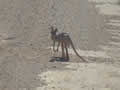
We saw this tiny figure in the middle of the road, but didn’t know what it was. It looked to be struggling to get up and run, but then it fell over and was deathly still.
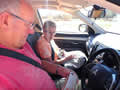 John got out of the car and picked the little figure up; we could see that it was a tiny kangaroo, so young that it didn’t have any fur. It shouldn’t be out of its mother’s pouch yet, but there was no sign of Mama. I walked the edges of the road but didn’t find a body.
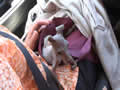
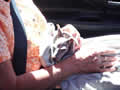 The little joey was shivering, probably from the cold as it was 12C, and sneezing, but seemed uninjured. He was wrapped in Edna’s sweater and popped into a shopping bag, a substitute for Mama’s pouch. He wouldn’t drink but licked water from Edna’s fingers.
The plan was to take him to the park in the hope that the rangers could care for him. We just hoped that he would survive that long.
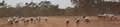 We were at least 100K from the administrative area. The roads in that area are quite good but even the smooth and hard sections are at odd angles and punctuated by craters of soft sand. It would take us at least two hours, plus time for woolly traffic jams like this one. Joey was getting bounced around but that’s normal for kangaroos. He fell asleep a few times.
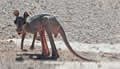
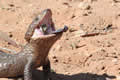 As well as flocks of sheep we met more wildlife along the way, more kangaroos, an eagle and numerous stumpy tails. At one
 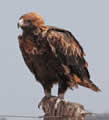 point Edna was trying to get a clear picture of the eagle, but John couldn’t move the car because a stumpy tail was in front of its tyres, and she couldn’t move as she had a kangaroo in her lap! Yes, it was an interesting route we’d chosen.
I’d wondered why the eagle was tolerating our presence so long and realized why when I looked at my pictures. Its tail had few feathers and it could not fly properly. It probably needed to go to a rehab centre too but I don’t think any of us was going to volunteer to travel with an eagle on our lap!
|
Wounded eagle (4.38) |
 |
|---|
|
Mungo Joey transit (0.34) |
 |
|---|
Eventually we could see a line of white cliffs above the otherwise flat plain. This was probably part of Mungo’s Walls of China, sand dunes formed when the lakes dried up and the sediments were blown away.
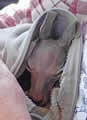 The park’s visitor’s centre was empty of rangers; most of them were off in other parks fighting fires. Eventually we found the Mungo Lodge, and Joey was passed to Sandie while John and Edna went looking for help. A bus was unloading guests to the
 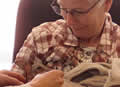 lodge and Sandie spotted a lady with a parks badge, and asked if she could help us. I’d feared that we might be told to take him back to where we’d found him and let nature take its course. But this lady was obviously delighted to have us bring in a little orphan to be cared for.
We were taken into her office and she fed Joey with water from an eye dropper. He was then sucking on Edna’s sweater where the water had spilled. She explained what they usually do with orphans. He’d be transferred to a bag of theirs, fed with water and goat’s milk, and given to their bus driver to take him into town to a lady who’d care for him until he was old enough to be returned to the wild.
She said he was a western grey kangaroo and about a month old, perhaps the youngest they’d had brought in but he seemed to be well and uninjured so his chances were good. We had the option of driving him there ourselves but we wanted to see the park and needed to find somewhere to sleep. With some reluctance the ladies handed Joey over and said their goodbyes. We celebrated his survival with coffee and scones.
 As we left the lodge we saw one of the staff walking up and down with a tight little bundle held to her chest… Joey must be fretting.
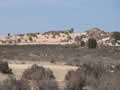
We set off to explore the park and drive the scenic loop up into the Wall of China. We’d all been to Mungo before but John and Edna had not driven the loop road.
|
Mungo Park (2.59) |
 |
|---|
40000 years ago the lakes had water and this was a productive area supporting a sizable population. The skeletons of Mungo Man and Mungo Woman are famous as the earliest examples of cremation and the coating of dead bodies with red ochre. More recently the climate had changed and by 15000 years ago the lakes were mainly dry.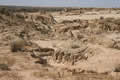
The dunes of the Wall of China have been heavily eroded, particularly in modern times when sheep were grazing the plant 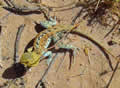 cover. This led to the discovery of the archaeological treasures, but also the creation of canyons and spires, a “Badlands” landscape.
We visited the remains of the sheep station: a homestead and a woolshed and water holes. They had some boom years here which led them to double the number of sheep, but there were also multi-year droughts and plagues of rabbits to deal with; not an easy life!
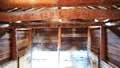 They dug out this pit at the homestead where they could go to escape the heat. The woolshed was built from corrugated iron
 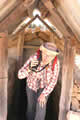 and must have been unbearably hot in the summer.
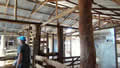 After a picnic up beyond the wall, we left a bit late as usual, with about 100 miles to drive to the Mildura area. The road was slow of course with the usual crazy angles and soft spots. We took the first motel we saw, the Edge in Buronga; we were just in time for dinner before the restaurant closed.