2004/02 New South Wales loop - The Sheepyard |
|||
The lady at the general store suggested we ignore the signs, or go over to the Sheepyard, as they weren’t so fussy over there. The Sheepyard was just that until thirty years ago when someone picked up a piece of opal there. Now it’s a maze of holes and piles of rock and ancient and modern machinery.
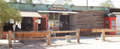 The cultural centre is the Sheepyard Pub, a shack with its own British phone box and parking meter. It’s not even a real pub. It’s a bottle shop which means that they can only sell bottled beer. If you want a glass you have to bring it in and pour the beer yourself. The pub was patronized by miners and noodlers. A paper on its notice board proclaimed “wanted: Bogger”. We found out later that a bogger is a little truck that’s used to transport opal ore underground.
The pub’s owner had retired from a nickel mining company in Cobar, and bought both the pub and a couple of the nearby opal mines. He was a lot of help to us. He said that we should go to the tailings from the biggest commercial mines. Those operators are required to dump their tailings on designated public lands, and noodling is allowed there. The big guys also miss a lot of the good stuff. They use machines to dig the rock out during the day and then process it in an army of modified cement mixers overnight, turning the rock into a slurry. Human beings have to then sort through the slurry and they don’t find all the opals.
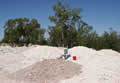
So we went to the public dump and started going through the heaps of tailings. It’s relatively easy to find “potch”. That’s grey or white opal, and it’s worthless, but sometimes it has flecks of colour in it, reds and yellows and greens. It’s quite a thrill to suddenly see a flash of colour in a pile of white rock. Unfortunately, the “colour” is often very thin, which is why there’s such a big trade in opal doublets and triplets. These have only a thin veneer of opal sandwiched with quartz and other rock. We came away with a bucket full of pieces of likely opal for processing at home. Oh, did I mention that it was 110 degrees?
We drove back in dusk and darkness, dodging sheep, cattle, and kangaroos.
Sunday February 29th
In the morning, we drove out along the Green Door trail to the monument marking the first mine sunk in the area. The hole is still there, covered over with a grid. They are a little better here with the rules for covering or filling disused mine shafts. Over in Coober Pedy they just had signs warning you not to walk backwards. The mine next door was still active as was plain  from the “Tourists keep out” and “No specking” signs.
Sandie wanted to visit the mines at Coocaran, but I took the wrong turning. We tried to drive cross country to get there but we were blocked by fences and private land, so we gave up and headed over to the Sheepyard again.  At one point the
 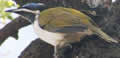 road was alive with bugs, crickets we thought. No choice but to crunch our way through.
At the Sheepyard mine dump we filled another bucket and got to meet some other noodlers, and then retired to the pub. Apparently a couple noodling at the dump had recently found a spectacularly good stone, which fetched over ten thousand. As they were flat broke beforehand this was a good rags to riches 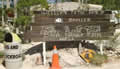
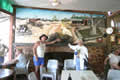 story. It may even have been true.
The pub owner gave us directions on how to get out to the main road to the west, but we were almost immediately lost in the maze of tracks. The miners make their own tracks to their mines. This time the GPS saved us, as we drove until it showed us as being on the real road and then we stuck with it. Nobody bothers to maintain the road, so it’s in far worse condition than the tracks, with a knee-deep ditch running down the middle and giant holes every few yards. Any vehicle less agile than our Landcruiser would still be there in the ditch. At one point the road was blocked by a downed tree and we had to take to the bush until we could find a wide enough path through the trees for us to get around it.