2018/02 Costa Rica - Manuel Antonio NP |
|||||
Sunday February 25th
Diego collected us in a van at 7.30 am on what turned out to be a private tour. Manuel Antonio is Costa Rica’s smallest national park but because of its location next to a vacation town it’s also the most visited. It’s being milked to fund the rest of the park system,
 The entrance is down a side street just off the beach. We queued up with Diego and dozens of others to enter the park. There is a daily entrance limit; most visitors are only interested in its gorgeous beaches. Beyond is a wide gravel path; those interested in the wildlife are going slowly with their guides while the beach people are hurrying along to find a good spot.
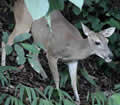
Diego, like most of the guides, was carrying a spotting scope. He would see something, stop, and set up the scope so we could see a distant bird/bug/sloth; we’d look through the scope and then try to find the animal by eye or camera. Sandie would find things before me, but people without a guide, even those glancing around for wildlife, would likely see nothing. The only exception would be this white-tailed deer, hard to miss, and reminiscent of Minnesota.
 |
Park tour (2.30) |
 |
|---|
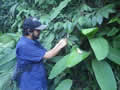
Sandie took this circular picture through the spotting scope. The bird is a motmot, similar to what we’d seen the night before. The only way I could find it with my lens was by the tiny blue patch on its head.
The pictures in this composite show how hard it is to see animals in the jungle, even when a guide is pointing them out. Top right is a view of another sloth, fast asleep in the treetops during the day. Top left is a rarity according to Diego. It’s one of a troop of red-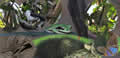 backed squirrel monkeys, only found in a few places. There is a much better picture of a squirrel monkey later in this journal. Most of the rest, like the bird, are difficult to identify.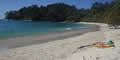
We came out to the beach, Playa Manuel Antonio, where a porcupine was just visible up in a tree along the shoreline. We were all struggling to get a view of it, even getting caught by an incoming wave, but most of the porcupine (centre bottom) remained hidden. 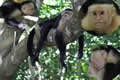 The beach was busy; this is where most of the park’s visitors had been headed, so the porcupine wasn’t likely to move.
We were supposed to return with Diego to the entrance and be escorted back to our hotel but he gave us the option of staying in the 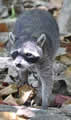 park. There were still trails to explore so we said goodbye and set out on our own.
|
Beach trails (6.22) |
 |
|---|
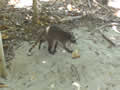
It was apparent that nature was adapting to profit from the crowds. Raccoons and capuchin monkeys were opening and stealing backpacks, while iguanas were begging for food and cleaning up picnic sites.
|
Raccoon thief (1.19) |
 |
|---|
These southern raccoons looked to be a bit smaller than ours, with less distinct markings. Capuchin monkeys have human-like faces but they are definitely monkeys; I noticed than whenever we passed on the trail, the monkeys would look at my back to see if I had a backpack. 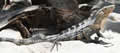 When we sat down for a minute this large iguana came tumbling down the cliff behind us in a shower of rocks, scared that it was late for the picnic.
Trails took us up and around the Punta Catedral, the headland we could see from La Mansion. The trail should have been easy but 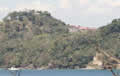 many of the steps were just a bit too high for smaller people to climb and were jarring on descent. There were viewpoints out over the ocean and beaches, one with this distant view of our hotel.
We watched another iguana chasing a large lizard, just like in a Tom and Jerry cartoon, zigzagging through the leaf litter. The lizard took an arc around me and the iguana took the direct route launching itself between my legs and it caught the lizard right behind me. Its tail was dangling from the iguana’s mouth. Sandie regrets not capturing my expression.
The sky was busy with pelicans; they were brown pelicans, the ones that dive full-tilt into the sea, but these were just cruising, not  fishing.
|
Return through park (4.52) |
 |
|---|
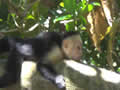
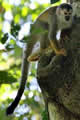 We found a nice trail back across the swamp towards the exit, quieter as it was too narrow for the spotting scopes. There were hundreds of these colourful honeymoon crabs below the trail. I also got this better shot of a squirrel monkey, though at the time I thought it was another capuchin.
Almost back, we found another even quieter trail, this one leading to “the waterfall”. As it was the dry season I wasn’t too enthusiastic; it looked like a lot of climbing to what might be an Australian-type waterfall where we’d stand underneath it and look for the damp spot. It turned out to still be trickling, a good place to see birds, but the terrain was mostly jungle, too dark for pictures of moving birds.
On our way back we met a French family who had just watched a snake catch and begin to swallow a frog. They said it had got stuck and they pointed to where they knew the snake to be but we never saw it.
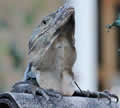 By this time I could hardly walk and we were hungry and thirsty and dived into the first bar that had a food menu showing. This iguana was there with the same mission, perched on the roof, watching us eat. I forget what we ate but it went down well and gave me enough strength to stagger around the corner to the beach’s taxi rank.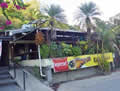
Back at the hotel our neighbour, a large fat guy from Iowa with a bare chest, came out onto the balcony to feed the iguana, but this time there was one of those rare squirrel monkeys there too. He fed chunks of banana to the monkey which was squealing away in monkey talk “Come on guys, we got a sucker here!” Within a few seconds we had three monkeys and then ten. Iowa guy tried to feed the newcomers but he was too slow and one of them launched itself onto his bare chest, hanging from his boobs. 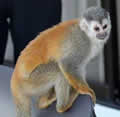 There was a lot of screaming and dancing; unusual entertainment for the rest of us. No one permanently harmed.
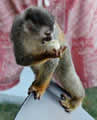 Our first reaction to the monkeys’ visit was to doubt their rarity. “They’re not rare; they just moved from the jungle to the hotels. ” Their problem is they are just too cute for their own good. Their pictures even show up in messages from our phone company, especially if they are raising their rates. Seriously though, they have been badly affected by the pet trade. I heard a recent radio programme about the history of comic book advertising; not too long ago, kids could buy a squirrel monkey and have it delivered by mail, always a tragedy for the monkey and often for the kid, who’d open his parcel and meet a thirsty and seriously unhappy monkey.