2018/02 Costa Rica - Road to Sierpe |
|||||
Monday February 26th
Sandie found that she had a ghastly looking bright red rash around her ankles. It didn’t hurt or itch but we had no idea what had caused it. The rash slowly faded over the next few days. Our guess later was that the permethrin spray we’d used for our safari trip was still active in Sandie’s trousers and getting them wet with seawater had turned it into something nastier. Permethrin cream is known to cause rashes if left on too long.
W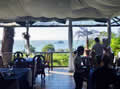 e had to pack up for our transfer to the De Osa peninsula, but first we needed breakfast. In the light of the monkey incident we’d been discussing how the hotel kept wildlife out of the restaurant. As the picture shows, there is only a short glass wall between diners and the outdoors. What stops bugs from visiting the lights or monkeys from joining the diners? We still don’t know, but during breakfast a large iguana dropped down from the garden, pooped by our table, next to the railing, and did a round of the tables looking for handouts. A waiter came and cleaned up the mess, but wisely left the iguana alone.
Our driver took us southeast along the coast road, mostly though plantations of royal palms. He pointed out the location of an earthquake about ten years ago. The land between the road and the coast had collapsed, killing lots of people.
The isthmus of Costa Rica and Panama is thought to have formed as a result of plate subduction, with the Cocos Plate sliding under the Caribbean plate and forming a line of volcanoes. South and North America had been separate but on a slow collision course, each with its own zoo of animals. So Costa Rica has interesting geology, but at the cost of eruptions and earthquakes. It also has extreme biological diversity as those two zoos attempt to populate the other continent. It’s still going on, of course. We noticed on our Chile trip that South America has no crows; it has caracaras instead and so far the crows have not prevailed and crossed the isthmus. 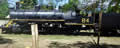
We turned off the main road at Palmar Norte, past Palmar Sud airstrip where we’d fly out from on Thursday. Nearby was this steam locomotive, built by Baldwin in the USA, and a relic of Costa Rica’s railroads, now almost disappeared except for some commuter lines.
The road ended at a dock in Sierpe.